Mustard Seed Autism Trust is a registered Charity providing support to autistic children, their parents and siblings. They provide occupational therapy, resources to help with social communication and emotional wellbeing and support groups and workshops for parents and siblings. Their services are constantly in high demand so their waiting list only opens very briefly several times a year. We were fortunate enough to be able to get Caleb on the waiting list last summer and he received an occupational therapy assessment, which included a school visit where the occupational therapist spoke to his teacher about ways to help him in school, and a 5-week block of one to one sessions on emotions and emotional wellbeing. These were provided for no cost to us at all. It’s a truly amazing charity.
It’s the five sessions on emotions, led by the wonderful Jen, that I’m going to be sharing about here… Before I get into it though, I wanted to ask for you to consider donating to Mustard Seed. As a charity, they rely on donations to carry out their work and, as I said above, their services are in very high demand. If 50 of you reading donated just £1, that would cover the cost of the resources for another child receieving emotional wellbeing sessions. You can donate here: https://www.peoplesfundraising.com/donation/emma-fundraises-for-mustard-seed. Thank you in advance! I also want to mention that I asked for the charity’s permission before writing this blog.
In the first week of the five sessions, we looked at regulated breathing, and how our breath can help us calm down. This involved blowing bubbles, blowing through straws, “blowing out” an LED candle and some calm breathing exercises.
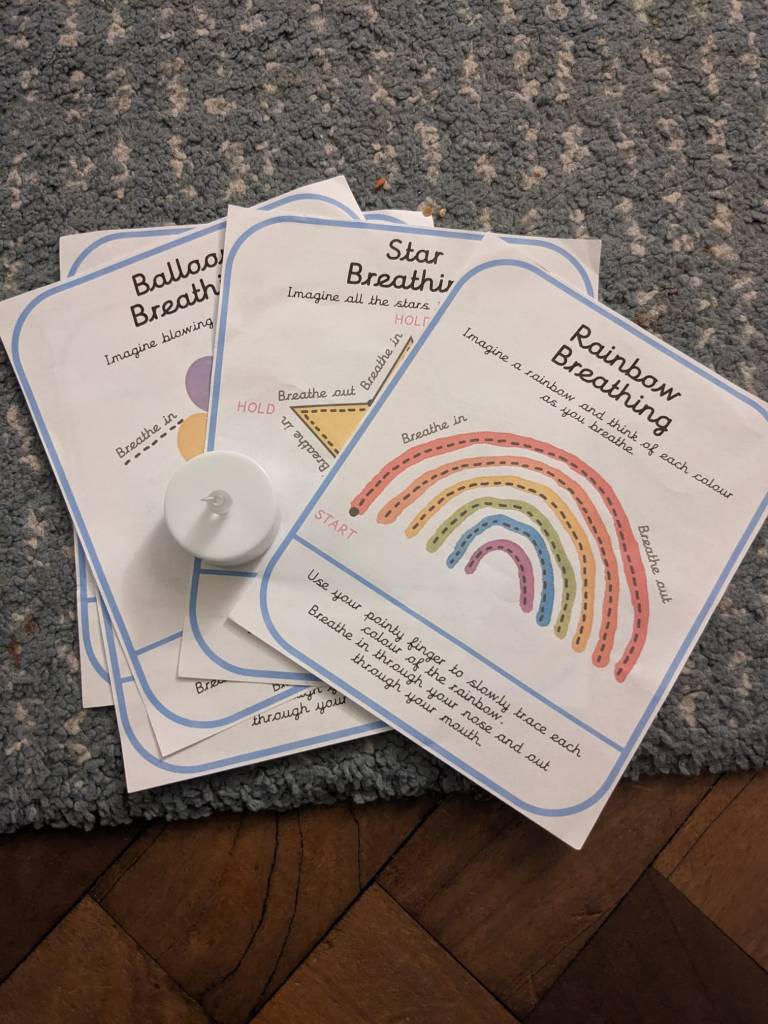
These breathing exercises (shown on the cards in the photo) have been really helpful in regulating Caleb and I’ve used them several times since the session. Even if he doesn’t do the breathing “properly”, the act of following my finger as I make the shape of a star, for example, encourages him to focus and be present so calms him down.
Week 2’s focus was push and pull. These activities engage a sense of proprioception, or body awareness. Examples of activities were wall pushes, tug of war, tearing recycling and jumping on boxes. Caleb really enjoyed the less destructive activities, like the tug of war, and he often does heavy work like pushing tyres as part of some occupational therapy at school. However, when we ripped paper he wanted it to be put back together so that aspect wasn’t great for him. But some kids love it!
Week 3 was focussing on deep pressure. This included doing exercises with resistance bands (which Caleb loves doing anyway), a body sock, a therapy ball, and (the real kicker) a weighted blanket. We have been considering getting Caleb a weighted blanket for a while. When Jen encouraged Caleb to lie down on the blanket and she wrapped him in it, it was like calm descended on him. It was the calmest and stillest I have seen him in a long time, potentially ever. He clearly really enjoyed the pressure on his whole body and the peace it brought him. We’ve now invested in a weighted blanket for him and he sleeps with it. Whilst he normally spends hours jumping on the bed at bedtime, he now lies still, watches The Snail and the Whale a few times and then eventually switches off (still much later than we would like, but there has been an improvement).
If you are considering getting your child a weighted blanket, it mustn’t be much more than 10% of their body weight, as a safety measure.
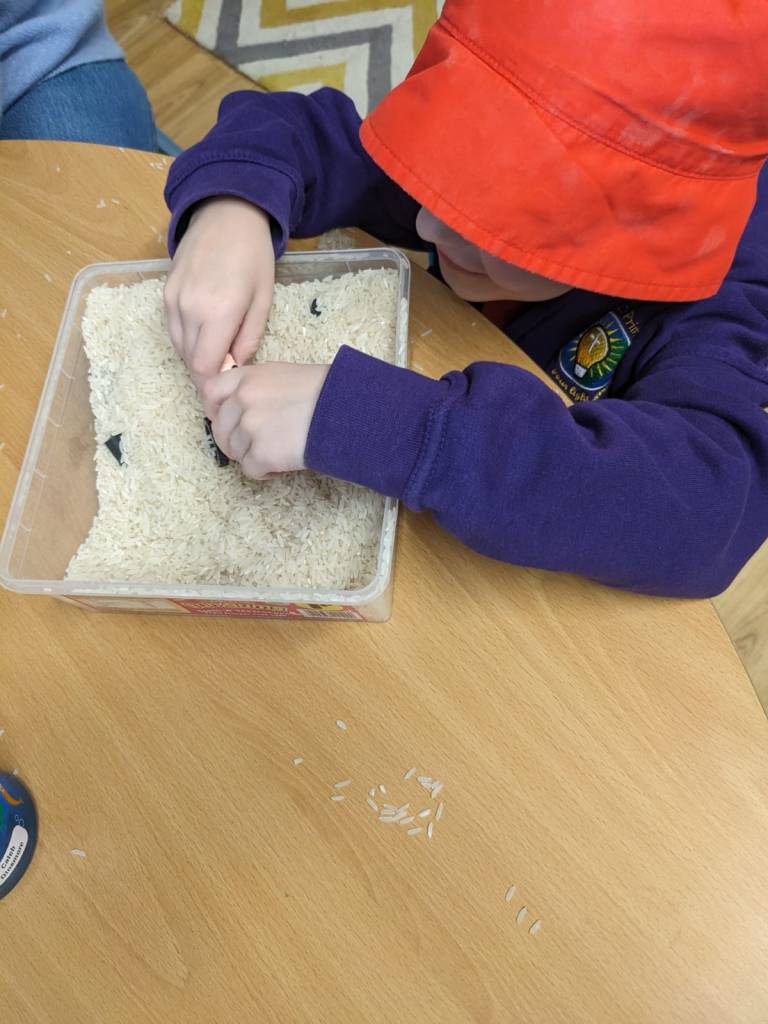
Week 4 focused on busy hands. These are activities that keep the hands busy to calm the mind. In the session, this included popping bubble wrap, playing with fidget toys and (Caleb’s favourite) a rice bucket. For this activity, Jen had a small box filled with (uncooked) rice with a few small toys hidden inside. However, Caleb just really enjoyed the feel of the rice in his hands so he spent a good five minutes quietly playing with it. We’ve since filled a box at home with rice but the girls use it to “feed” each other… But at least it gets played with.
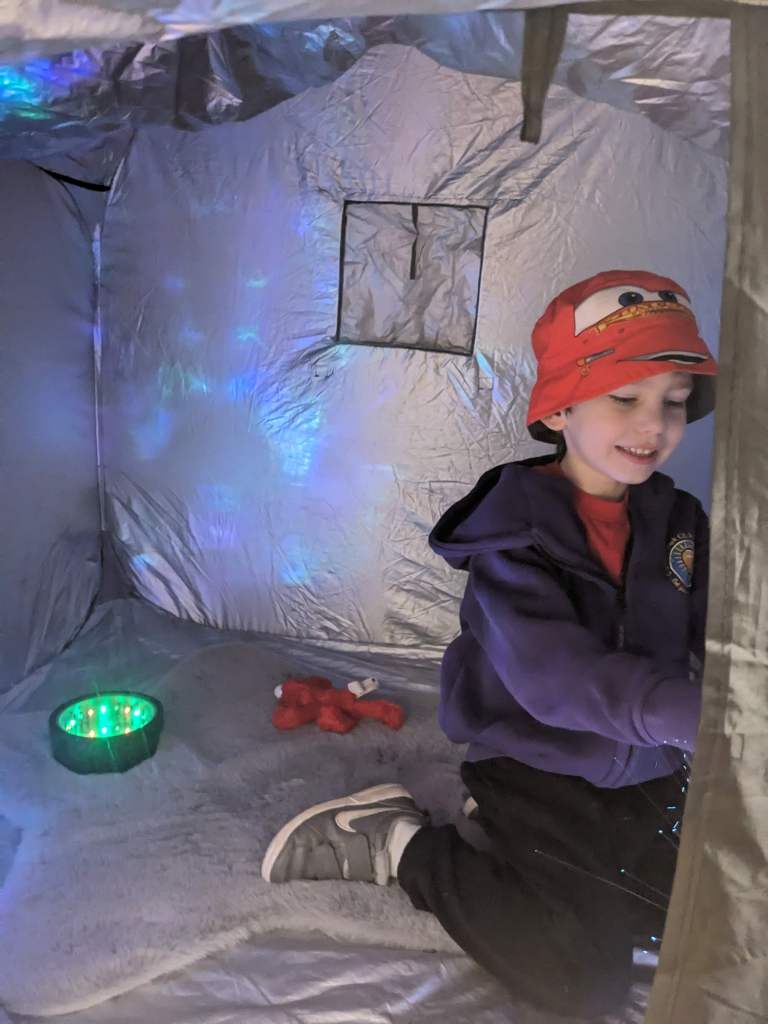
Week 5 was on den building. This was all about creating a safe, calming space for Caleb to hang out in. This could include blankets, colourful lights and gentle music. Jen brought out a sensory tent which is a fantastic small, dark tent with a slightly shiny interior. It is dark inside and when you also have some coloured lights in there, such as fibre optic lights, they reflect beautifully on the sides. We also put a lovely soft rug in there which Caleb was drawn to every session, and some fidget toys. This kept him quiet and calmly occupied until we needed to leave. Proper sensory tents are quite expensive, but I lucked out and got a small pop-up UV tent for free off Facebook. I’ve got a fibre optic lamp and I’ve managed to source the exact rug from the sessions off Vinted! You can see how the cost of fun sensory things can add up, thank goodness for DLA!
Every week, we did some animal walking/Mario Kart walking, i.e. walking about in the way we would imagine an animal or Mario Kart character would! This was Caleb’s favourite thing to do every week and he often asked me to film him in slow motion, which just added another level of fun. Moving and engaging his body in this way was a really fun tool to help Caleb regulate himself. It’s also a really easy, free thing to crack out when you can feel things getting tense!
There were various other games and resources we used each week which helped Caleb learn how to recognise and name different emotions. Some involved sorting images into categories of “happy” and “sad” and explaining why he made those decisions e.g. this one is sad because they are crying, this one is happy because they are smiling. He improved in this so well over the 5 week sessions, so at the end he could tell us of a time that he had felt sad, what had made him sad and how he had cried to express that sadness. This is huge for Caleb.
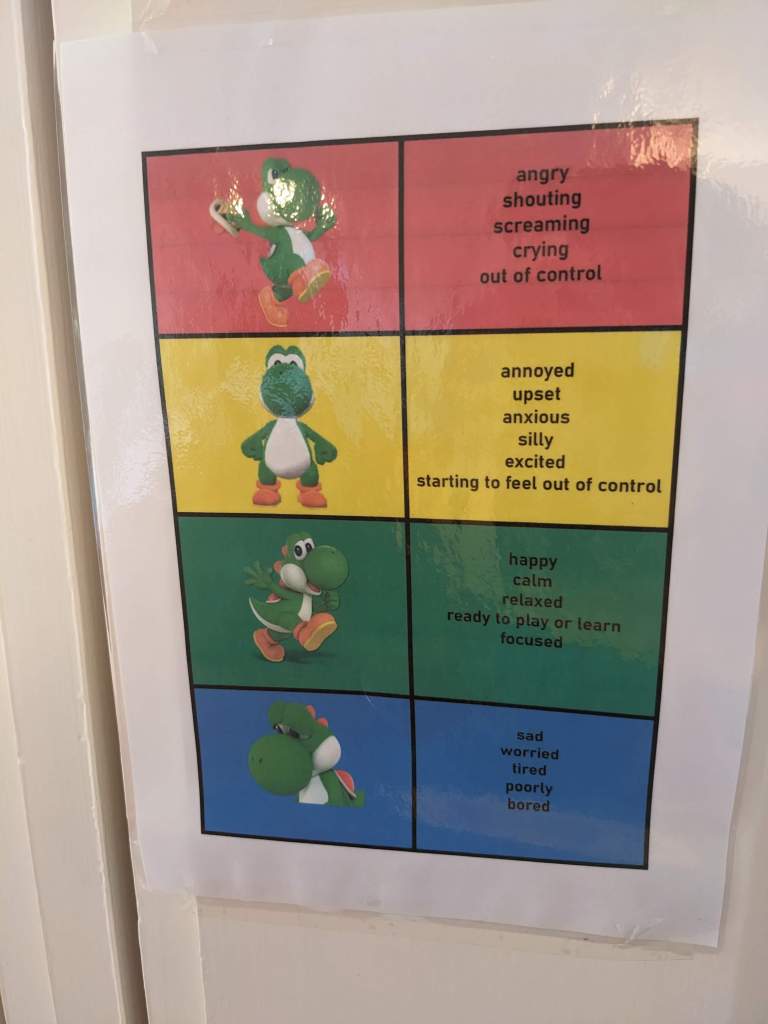
We also talked a lot about zones of regulation, which you may be familiar with if you have a child at school or work in a school. Jen made Caleb a wonderful chart including Yoshi because he’s in a Mario Kart phase at the moment and his cuddly Yoshi joined us at every session! Some children find it really useful to place their emotions into different colours, as a way to express simply how they are feeling. Caleb doesn’t find this that helpful at the moment but hopefully once he gets older, it will become a useful tool for him. Jen encouraged us to model how to use it, for example “I love it when you play with your sisters, that makes me feel really happy like green Yoshi/I’m feeling very tired and poorly today, like blue Yoshi”.
All in all, we learned an awful lot in five weeks and found some tools and strategies that can really help Caleb to regulate himself. Emotional dysregulation is a very common trait in autistic kids, but also lots of kids find it difficult to regulate their emotions, especially when they are young. So I really hope you find some of these ideas helpful and they help your child calm themselves too. Please can I ask you again to consider donating to Mustard Seed so that more children can gain access to this support: https://www.peoplesfundraising.com/donation/emma-fundraises-for-mustard-seed.
Is there anything specific you like to do with your child that helps them regulate or learn about their emotions? Let me know!
Other resources we used during the 5 sessions
These emotion stones were a really lovely tool to use by themselves or by pressing them into play dough.
This pineapple expressions game was a fun way to play with how a face might express emotions.
This emotions detective game was a fun way to learn about everyday conflicts, how they can make us feel and how to resolve them.
We used dominoes cards similar to these as a way to recognise and match up emotions.
 Emma Dinsmore