I’d like to talk to you all about unschooling. I have a lot to say, so this is a long one. Grab a cuppa and a cookie.
Now, before we entered the world of home education, if someone had said the word “unschooling” to me, I would have pictured hippies floating about with no rules with the kids running wild and naked through the woods. My opinions were definitely not positive. There had been one of those “Stacey Dooley sleeps over…” episodes about an unschooling family and it largely revolved around the facts that the kids had no set bedtime or mealtimes and the elder boy (I think he was 8 or 9) couldn’t yet read or write. The parents practiced child led parenting, perhaps to an extent that is unusual. They were portrayed as extreme, irresponsible and, basically, bad parents.
If you have read any of my other blog posts, or talked to us in person, you will know that we came to home education very reluctantly. In case you’re new here (hi ☺️), this is the story in a nutshell: we, and several educational professionals, believe that a special school is the most appropriate school for our autistic 6 year old son. The LA disagrees. All but one mainstream school said they cannot support his needs and there are no spaces in special schools anyway. Hence, home education.
To get started, I found tonnes of resources. I scoured Vinted for workbooks, got a Twinkl subscription (which has actually been fab), found fun activities, planned weeks ahead and researched for hours how to educate at home. We also got a tutor (provided by the LA) who was due to come 10 hours a week. And our son didn’t want to do any of it. What I was dreading would happen happened and he just wanted to stay in his room watching videos all day and never wanted to leave the house.
This is apparently very common at the beginning of home education (if a child has previously been in school) and it is necessary for both parents and children to go through a process of “deschooling”, basically moving away from the idea of what you think education should look like. For me, I was picturing our son completing worksheets and reading, so long as he was able to jump up and run around when needed. Whilst I wasn’t planning on replicating school at home, I definitely had an idea of how Caleb should learn, and I planned to include all the movement and sensory breaks his heart desired. But it wasn’t enough.
For weeks our son was highly dysregulated and could barely be in the same room as the tutor for 5 minutes before running upstairs. We had thought keeping him home from school would magically make him into a calm, stable, happy little child but of course it wasn’t that simple.
After steadily cutting the time the tutor came in over a week we decided to pull everything right back and only had her come in one morning a week for a couple of hours. Our son was also attending a fantastic alternative provision (where he was the only child) once a week for a couple of hours, which we were able to leave him at. After several weeks of settling in, being unable to do a full session because he was so tired, another child joined and finally he was able to cope with a full session because the attention wasn’t all on him.
In our attempts to help make our little boy feel safer and happier, we pulled back entirely and decided to just let him do what he wanted while he was at home. For a while, that was just watching videos and playing with his toys. Occasionally we could manage a trip to the park or beach and things started to feel a bit calmer.
Then we noticed something happening. Our son was watching lots of videos, often songs, about the human body. Sensing it was something he found interesting, we provided him with some books and very simple activities, such as labelling different parts of the body (think head, arm, leg). But then we noticed that our son was talking more about internal organs and the digestive system and the pyloric sphincter. We were suddenly learning things from him that we had never known before! His brain was soaking up all these facts like a sponge and he was able to recall information that was far beyond his years.
So we fully dived in with him and our lives became absorbed with learning about the human body. Now he wasn’t just watching videos, he was also reading kids textbooks and examining diagrams and making human organs out of play dough. It all came from him and we just hopped on for the ride, slipping him more resources and activities when we found them.
Thankfully, when we felt like we had truly learned all we ever needed or wanted to know about the human body, a new topic of interest emerged. The American states. Then maps. A brief foray into space. Until we landed where we are now, in countries of the world.
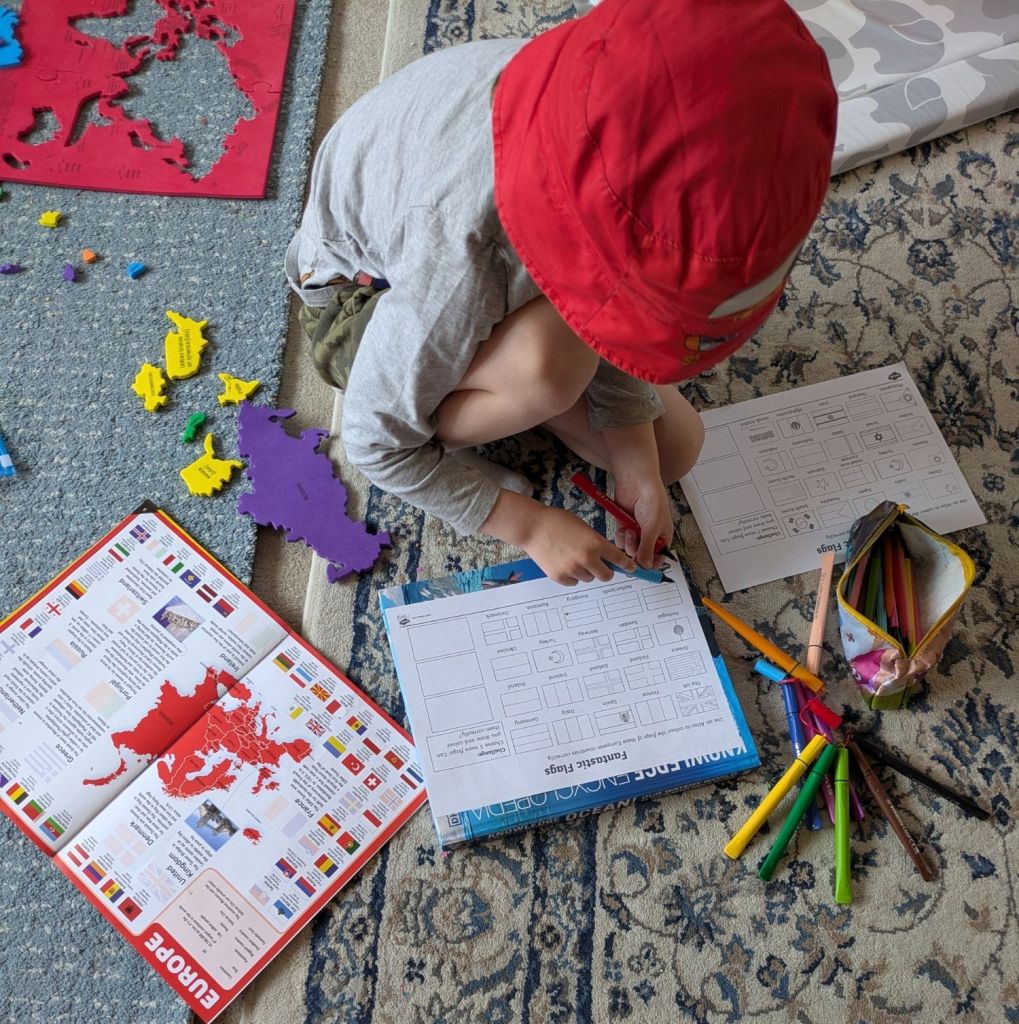
Now that I’ve got my bearings a bit more, I’m more able to think of ways to expand and facilitate his learning (for example when learning about the USA states, I found the flag for each state and we would match them with the maps Sam and I had meticulously drawn). So since we’re on the countries of the world, I’ve been printing out flags for us to colour and found puzzles where each piece is in the shape of a country, so he can literally make the world. A lot of the learning he does is very tactile, he constantly asks us to draw countries/regions/counties, so he can put together continents/countries or states. If I never had to draw the outline of a county of an American state again, I would be a happy girl. He will make countries or states out of play dough, and stick a pair of googly eyes on them for comedic effect.
This is unschooling. Our son decides what he wants to learn, how he wants to learn about it and when he wants to move onto something else, be it a new topic, a new activity or going outside to bounce on the trampoline. He dives deep into his interests in a way that would just be impossible in a school environment, mainstream or otherwise. For him, there is now no separation between learning and play. He learns through play and plays with learning. Whilst we can find this exhausting as there is no “off time” from education, he is just thriving.
Of course, unschooling is not a perfect solution and there are many challenges to it. I have found it really difficult not having any control over what our son’s learning and I worry about his reluctance to handwrite or read fiction. We haven’t done any kind of maths in months and whilst he can read well, he struggles with comprehension. The lack of time alone, isolation and relentlessness of home education has taken a real toll on my mental health. I find it so overwhelming a lot of the time and we haven’t found a local home ed community to build relationships with, so it’s very isolating.
Whilst our son is really enjoying his time at home, he still struggles with things like sensory overload and emotional regulation, especially when he’s tired. Whilst we have removed a lot of demands from him by keeping him out of school, we can’t protect him from everything, especially not his whirlwind twin sisters.
At the moment, our plan is still to send our son to a special school once his EHCP has been updated (currently in the tribunal process) and once a special school place is available (they are like gold dust). Therefore, we are probably looking at continuing with our home education, unschooling, journey for at least the next year. Whilst this thought occasionally fills me with dread, I’m also intrigued and excited to see what topic our son chooses to dive into next. I’ve been asked whether we have any influence in his choices and the truth is, we really don’t, it’s a surprise to us too!
So we’ll just join in wherever he goes and hope that it involves less of us having to draw things.
 Emma Dinsmore